Start with commercial truth
Connect baseline sales, margin, purchase frequency, audience eligibility, and promotion cost so the model reflects how value actually moves.
 Book a demo
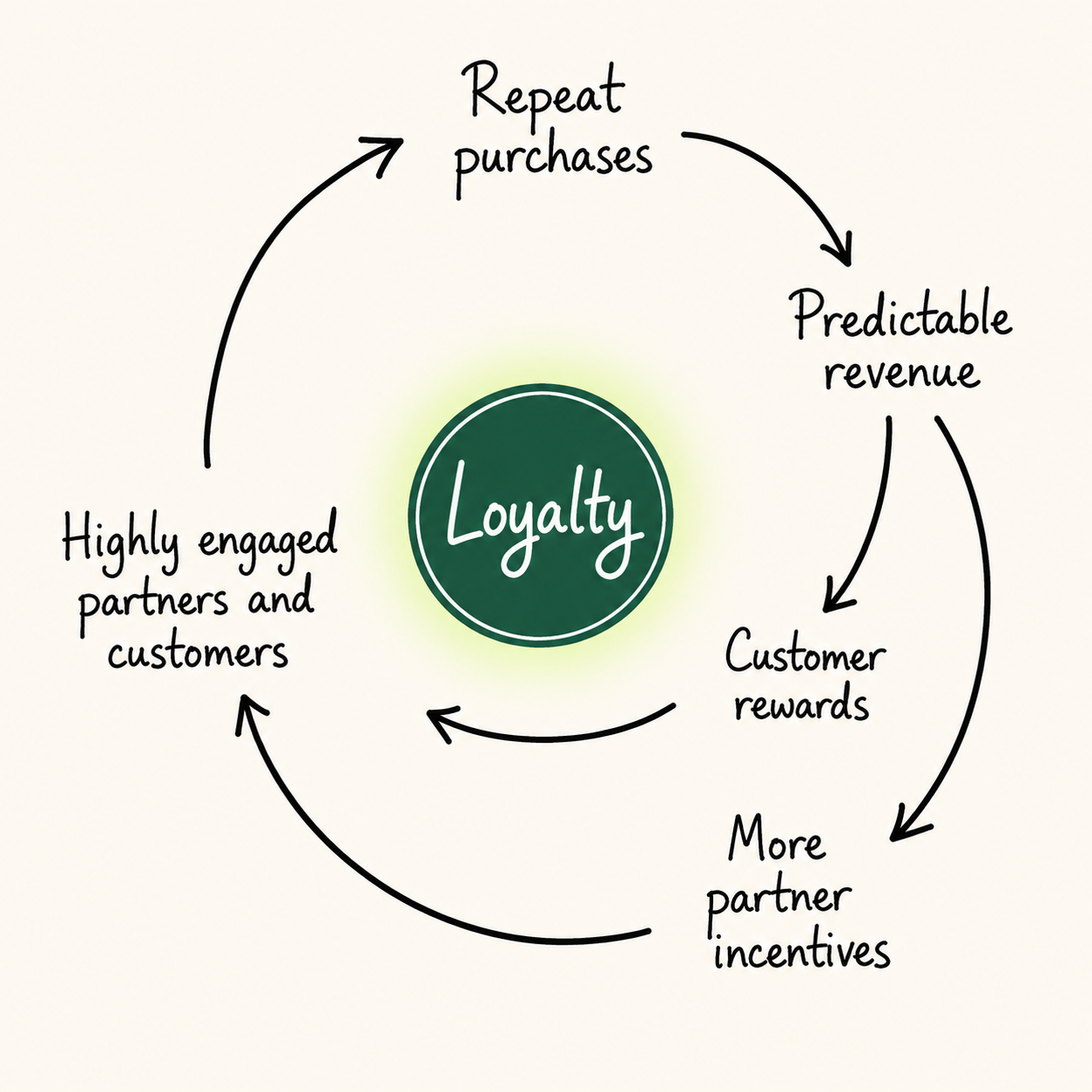
The Sepals Loyalty Flywheel
Sepals helps brands and service providers model sales-incentive programs, simulate ROI before launch, and turn every result into a better next decision.
From intuition to evidence
A loyalty flywheel becomes more valuable when each incentive produces evidence for the next one. Sepals combines program rules, audience behavior, transaction economics, and historical performance to model likely outcomes before launch.
The simulation is not a promise. It is a decision tool that makes assumptions visible, exposes diminishing returns, and helps teams compare a broad promotion with a more targeted alternative.
Illustrative customer scenario
Consider a brand planning to run the same 2× incentive across an entire product line for two years. A simulation shows strong early response, followed by saturation and diminishing incremental lift as participants begin treating the multiplier as the new normal.
| Scenario | Promotion spend | Incremental contribution | Return on promotion spend |
|---|---|---|---|
| Blanket 2× promotion | $294K | $148K | 0.50× |
| Modeled targeted program | $118K | $168K | 1.42× |
Illustrative figures only. Actual forecasts depend on customer data, margins, eligible audiences, program rules, behavioral assumptions, and market conditions; results are not guaranteed.
How the model works
Sepals makes each assumption inspectable so sales, finance, channel, and loyalty leaders can evaluate the same commercial case.
Connect baseline sales, margin, purchase frequency, audience eligibility, and promotion cost so the model reflects how value actually moves.
Compare multipliers, segments, product groups, thresholds, duration, and budget caps before exposing the full ecosystem to an offer.
Estimate lift, saturation, cannibalization, contribution, and spend against a simulated control before launch.
Replace assumptions with observed performance, refresh the model, and make the next promotion more precise.
The compounding loop
Sepals turns a one-time promotion decision into a learning system that can strengthen engagement and improve promotion efficiency over time.
Flywheel questions
The model helps teams challenge assumptions early while keeping live measurement central after launch.
Sepals can combine baseline transactions, participant behavior, margins, audience rules, incentive cost, and historical response patterns to estimate how different scenarios may change revenue and contribution.
The model should show the assumptions behind the forecast so finance and program owners can change inputs and compare alternatives.
A broad multiplier can reward transactions that would have happened anyway, train participants to wait for the offer, and spend heavily on already-loyal segments. Initial lift may fade as the promotion becomes expected.
Targeting the multiplier toward a new segment, cross-sell behavior, certification, renewal, or incremental threshold can concentrate budget on change rather than habit.
No. Simulation helps teams choose a stronger starting point. After launch, actual sales, engagement, redemption, margin, and promotion-cost data should update the model and reveal where the forecast was right or wrong.
Useful inputs include customer or partner identity, product and transaction history, gross or net margin, baseline frequency, eligible audiences, past offer response, incentive expense, returns, seasonality, and commercial constraints.
See your scenario
Bring one incentive idea, the audience you want to move, and the economics behind it. We’ll show you how Sepals can frame the simulation.